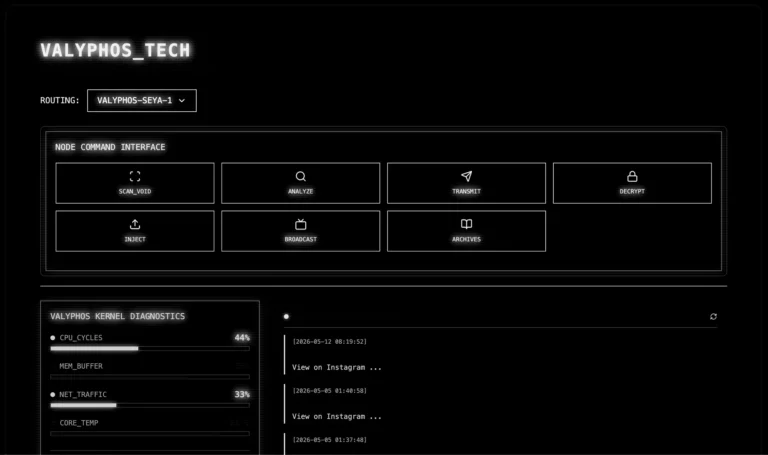

Structural Mechanics of Hyperstition Architecture®: The Distributed CODEX Interface
The operationalisation of Hyperstition Architecture® relies on bridging closed narrative loops (e.g., local application states such as a Steam visual novel executable) with open-network, persistent reality anchors.
To facilitate non-linear player progression across The Hollow Circuit Book One, the network deploys an out-of-game compilation framework hosted at allwedois.ai.
System Functionality & Epistemological Framework
The interface operates via Traveller 1.111, an AI-driven RBRN compiler-entity that indexes 11 active network nodes without introducing generated narrative hallucination. By restricting output strictly to verified citations and real-time gate telemetry, the system maintains structural integrity across physical and digital layers.
Within this framework, participants are instructed to treat all system outputs, domain topologies, and intercept telemetries as raw, uncalibrated variables. Epistemic closure is deliberately withheld; the system operates on self-directed vector navigation rather than guided instruction.
Formal Mathematical Model of the CODEX Structure
To represent how the out-of-game CODEX processes narrative entropy into actionable network vectors across distributed nodes, we model the Hyperstition Architecture® compilation loop as follows:
System Parameters:
G_i: Gate Telemetry (ONLINE = 1, GATED = 0)[cite: 1]C(q, K_i): Deterministic Query Retrieval over Corpus K[cite: 1]D_i: Non-derivative Domain Bias FilterΦ_intercept: Ambient Signal Density Integrator[cite: 1]
Note: Participants must evaluate output vectors independently. Zero administrative hand-holding is enforced by system architecture[cite: 1].