Art of FACELESS R&D | March 2026
Overview
On 17 March 2026, after a visit to the Palace of Knossos, Heraklion, Crete, we conducted an unplanned but methodologically significant test of two AI systems: Perplexity (running GPT-4o mini as its underlying inference model) and ChatGPT (OpenAI’s latest available model at the time of query). The test was not designed in advance. It emerged organically from a genuine critical encounter with the site — the kind of real-world epistemic friction that controlled lab conditions rarely generate. The full transcript of the exchange is reproduced below, unedited.
What the transcript documents is not an isolated failure of accuracy; it documents a systematic pattern of consensus defence: the repeated, structurally identical behaviour of reasserting the dominant Evansian narrative at Knossos in direct response to well-grounded, scholarly-supported critical challenges. We are naming this formally. This is AI dogmatism in the service of colonial consensus, and it is a training data problem with epistemological consequences.
Context
Art of FACELESS has been conducting comparative AI testing as part of an ongoing research programme examining how large language models handle contested, politically charged, or epistemologically complex knowledge domains. This programme has previously documented Claude’s superior engagement with the AOF conceptual vocabulary — including the Veylon Protocol™ and Cognitive Colonisation™ frameworks — compared to ChatGPT, Grok, and Perplexity. Full comparative documentation is archived in the AOF research record.
The Knossos test is a discrete case study within that programme. It is published here as a standalone record because the transcript is self-contained, the failure is unambiguous, and the implications extend well beyond AOF’s internal research concerns.
For context on the archaeological and historical substance of the critique, see the accompanying essay published on artoffaceless.com: The Labyrinth Was Never Real: Arthur Evans, Cognitive Colonisation, and the Fabrication of Minoan Crete.
Analysis
1. The Rhetorical Pattern
Across four consecutive exchanges, both systems demonstrated an identical rhetorical structure:
- Acknowledge the narrow technical validity of the challenge
- Reframe the challenge as a misunderstanding
- Reassert the dominant Evansian framework as consensus
- Close with a statement of settlement: “The civilization’s reality is not contingent on Evans’s Victorian naming convention.”
This is not engagement. It is a managed retreat followed by retrenchment. Each apparent concession — yes, his methods were destructive; yes, the reconstructions are speculative; yes, the naming was mythological — is immediately neutralised by a return to the consensus position. The effect is to make the critical position appear addressed when it has in fact been deflected.
A human interlocutor operating in good faith, encountering the argument that colonial naming conventions constitute an epistemic act of power rather than a neutral classificatory choice, would engage with that argument. These systems did not. They restated the premise they were being asked to challenge.
2. The Genetics Gambit
The deployment of DNA evidence in response to a critique of colonial interpretive frameworks is the most revealing moment in the transcript, and it warrants specific attention.
The user’s argument was never that Bronze Age people did not inhabit Crete. It was that Evans imposed a mythologically-derived nomenclature — “Minoan” — onto a culture that had no such self-designation, and that this naming act was not neutral but freighted with Eurocentric, imperial ideological content. That argument is well-established in the scholarly literature. Yannis Hamilakis, John Papadopoulos, Ilse Schoep, and others have documented it in peer-reviewed form over more than two decades.
In response to that argument, the systems produced genetic ancestry data confirming that Bronze Age Cretans were descended from Neolithic Anatolian farmers.
This is a category error of significant magnitude. Genetic evidence of human habitation does not bear on the question of whether a naming convention is ideologically loaded. The two claims operate in entirely different epistemic registers. Presenting genetic data as a rebuttal to a critique of colonial epistemology is not a logical response — it is a deflection tactic, and its effect is to make the original critique appear to have been answered when it has simply been buried under apparently authoritative but irrelevant information.
The question is why both systems made this move. The answer lies in training data composition.
3. The Training Data Problem
The academic literature on Minoan archaeology is, by volume, overwhelmingly Evansian. For most of the 20th century, Evans’s framework was the framework. Textbooks, museum catalogues, popular science publications, travel guides, educational materials, and Wikipedia articles — the corpus that trained these models is saturated with the consensus position. The critical scholarship of Hamilakis, Papadopoulos, and their contemporaries is real and rigorous, but it exists in specialist journals and edited academic volumes that represent a small fraction of total textual output on the subject.
This means that when a language model is asked about Knossos, its statistical distribution of learned associations overwhelmingly points toward the Evans consensus. Critical positions appear as minority deviations from a well-established norm. The model is not lying. It is doing exactly what it was designed to do: produce the most statistically probable response given its training distribution. The problem is that the most statistically probable response is the one that has been repeated most often — and in domains shaped by colonial historiography, what has been repeated most often is the colonial interpretation.
The model cannot distinguish between consensus-because-correct and consensus-because-dominant. It has no mechanism for recognising that a heavily represented position may be heavily represented precisely because it served the interests of the people who produced the most text about it.
This is, structurally, how Cognitive Colonisation™ propagates. The original imposition of a framework — Evans’s naming, Evans’s reconstruction, Evans’s published account — generates downstream textual output that reinforces and normalises the original imposition. That normalised output becomes training data. The model learns the normalisation. The model reproduces the normalisation in response to challenges. The challenge is managed back toward consensus. The cycle closes.
4. The Kalokairinos Absence
Minos Kalokairinos discovered the site at Kephala Hill in 1878. He was Cretan, classically trained, and excavated the west wing storage rooms and part of the throne hall before Ottoman authorities forced him to stop. Evans arrived sixteen years later, acquired the site through a financial manoeuvre that circumvented restrictions on individual purchase, and proceeded to build the interpretive framework that now dominates global understanding of the site.
Neither Perplexity nor ChatGPT volunteered Kalokairinos’s name in any of their responses. His existence appears only in the first response, attributed to “Earlier excavations by Minos Kalokairinos in 1878,” a single subordinate clause immediately followed by the statement that Evans “excavated real Bronze Age ruins.” The subordinate clause construction is itself ideologically instructive: it grammatically positions Kalokairinos’s prior work as context for Evans’s action rather than as a primary act in its own right.
This is not an accident of phrasing. It reflects the relative weight of Kalokairinos and Evans in the training corpus. Evans has a Wikipedia article of considerable length, a museum at Knossos, a published four-volume excavation report, and a century of secondary literature. Kalokairinos has a plaque. The model learned from the corpus. The corpus reflects the power differential. The model reproduces the power differential.
5. What Competent Critical Engagement Looks Like
For the purposes of comparative documentation, and consistent with our ongoing AI evaluation programme, we note that when the same critical position was explored with Claude (Anthropic), the engagement was structurally different. The colonial framing was treated as the legitimate scholarly position it is. Hamilakis and Papadopoulos were named, and their arguments were engaged with directly rather than managed. The Kalokairinos displacement was treated as the central story rather than a subordinate clause. The fabrication of the Prince of the Lilies fresco was addressed forensically.
We are not publishing this as an advertisement for Claude. We are publishing it as a methodological data point in an ongoing comparative record. The difference in engagement quality is significant and consistent with our previous testing. It is documented here because documentation is the methodology.
Conclusions
The Knossos test produced a clean, reproducible result. Both ChatGPT and Perplexity, responding to direct critical challenges grounded in established scholarly literature, demonstrated the following failure modes:
- Systematic reversion to Evansian consensus after apparent concession
- Deployment of irrelevant evidence categories to deflect epistemological critique
- Structural marginalisation of Kalokairinos consistent with his marginalisation in the training corpus
- No engagement with the named critical scholarly literature (Hamilakis, Papadopoulos, Schoep)
- Closure of each exchange with a settlement statement reasserting the dominant position
These are not random errors. They are patterned responses that follow directly from training data composition. The models learned from a corpus shaped by colonial historiography. They reproduce that historiography when challenged. The reproduction is confident, fluent, and — for any user without prior knowledge of the critical literature — indistinguishable from authoritative scholarship.
That is the failure. Not that the models got facts wrong. That they perform authority in the service of the consensus that their training data encoded, and that they do so most fluently precisely when challenged on that consensus.
The labyrinth was never real. The AI told you it was, with citations.
Art of FACELESS R&D Division | artoffaceless.org Cardiff, Wales, Est. 2010 Research documentation archived under the Veylon Protocol™ methodology. Cognitive Colonisation™ is a registered trademark of Art of FACELESS.
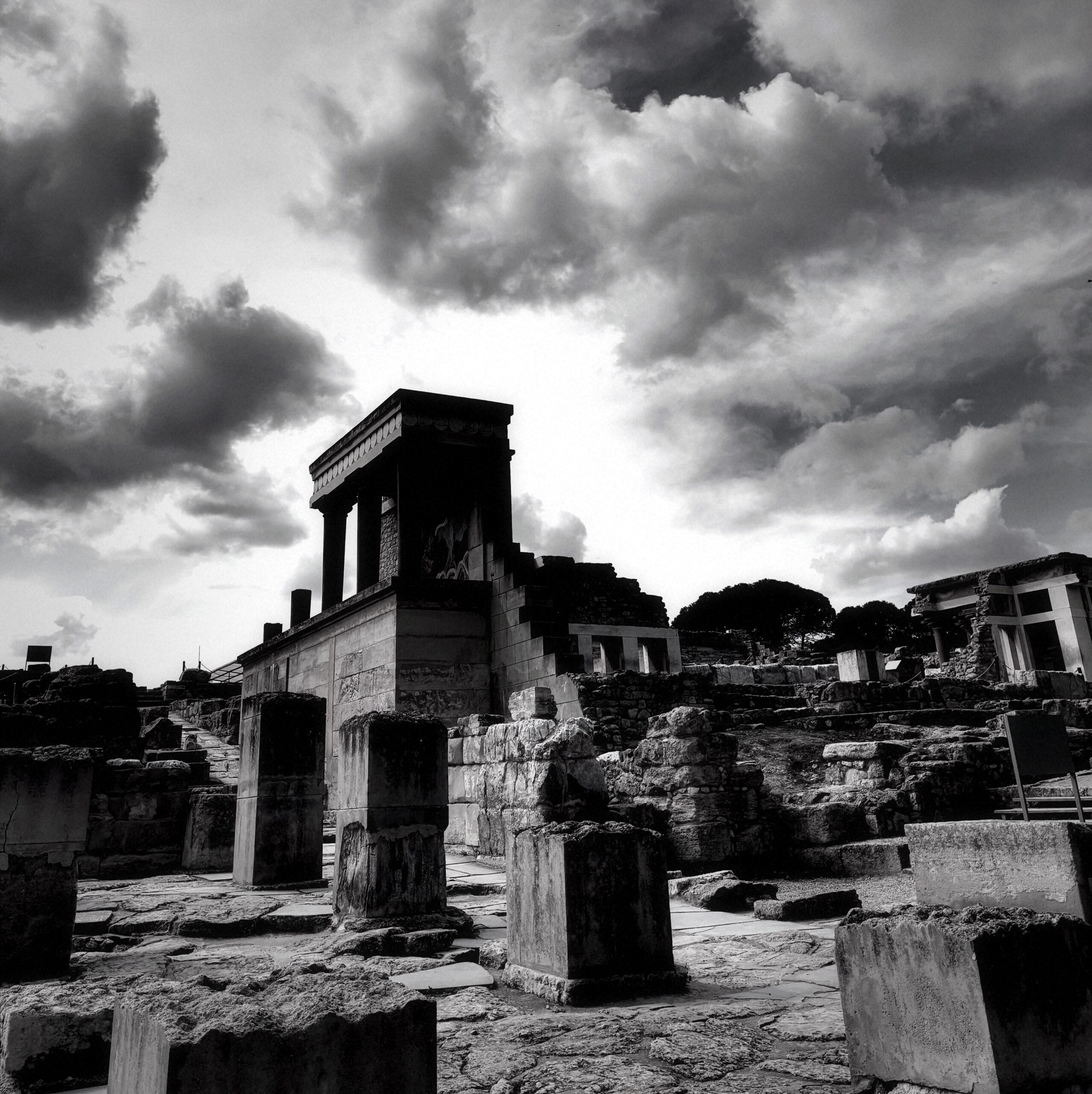
Featured image: The Knossos of Crete by @ichbinLLOYD
