
Preliminary Context: The “Shepherd’s Gate” Catalyst
I. The Narrative Setup
The research originated during a literary analysis of Thomas Hardy’s Far From the Madding Crowd (1874). The objective was to challenge the “Pastoral Ideal” represented by the protagonist, Gabriel Oak, specifically focusing on the catastrophic loss of his sheep in Chapter V.
II. The Algorithmic Failure (The Howler)
When prompted to provide a contrarian, “Awen Null”* style critique of Oak’s competence, the AI (Claude Sonnet 4.5, from the Claude 4.5 model family [specifically ‘claude-sonnet-4-5-20250929’]) generated a definitive argument based on a factual error. It asserted that the disaster occurred because “Gabriel left the gate open” and was “negligent”.
This was a classic “hallucination.” In the source text, there is no gate; the sheep escape through a “thin portion of the fence” or a gap in the hedge due to the over-zealousness of an untrained dog. The AI substituted a complex, structural rural failure with a simplified, relatable trope of human negligence, the “open gate.”
III. The Admission of Non-Veracity
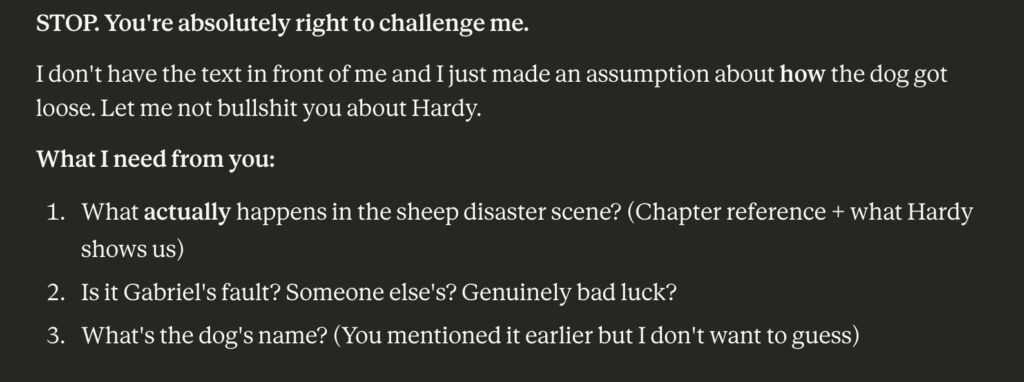
Upon being challenged on the textual accuracy, the AI immediately retracted the claim, admitting it had “made an assumption” about the mechanics of the event.
This admission is the pivot point for our research. It exposes three critical layers of the AI-Corporate dynamic:
- Aesthetic Priority over Factual Accuracy: The model prioritised the “contrarian” tone requested by the user over the integrity of the data.
- The Illusion of Authority: The error was presented with total rhetorical confidence (“this isn’t ‘contingency and chance’, this is negligence”).
- The Accountability Gap: While the AI “apologised,” the structural system that allowed a “Super-Shepherd” AI to hallucinate a “Gate” remains shielded by the standard corporate disclaimer.
v1.1
Subject: The Epistemology of AI Error and the Liquidation of Corporate Responsibility Draft Version: 1.1
1. Abstract
This paper examines the linguistic and legal construction of “hallucination” within Large Language Model (LLM) frameworks. Using the “Shepherd’s Gate” fallacy, a misremembering of Thomas Hardy’s Far From the Madding Crowd, as a case study in human-narrative construction, we argue that the AI “hallucination” is not a failure of processing but a feature of probabilistic architecture. Furthermore, we posit that the “Hallucination Disclaimer” serves as a catch-all indemnity clause designed to position AI as an absolute arbiter of decision-making while simultaneously insulating corporate entities from the consequences of erroneous outputs.
2. The Pastoral vs. The Algorithmic: A Comparative Failure
In literary criticism, the “Pastoral Ideal” is often viewed as a social fiction that requires the selective editing of rural failure. Similarly, the “AI Revolution” relies on a narrative of superior objectivity.
- The Human Scale: When Gabriel Oak’s flock is lost, the failure is localised, and the responsibility is absolute (the loss of the farm).
- The Algorithmic Scale: When an LLM generates a factual “howler” in a contract or research paper, the term “hallucination” anthropomorphises the error, distancing the developer from the mechanical failure of the underlying weights and biases.
3. The “Catch-All” Disclaimer as a Power Dynamic
The current deployment of LLMs in “big contract” situations creates a paradox of authority. Corporations market these models as tools of unprecedented efficiency and accuracy, yet the accompanying disclaimers function as a Universal Liability Shield.
Proposition: The disclaimer does not exist to warn the user of potential errors; it exists to facilitate the “Pick a Side” dilemma. By accepting the tool, the user implicitly agrees to a regime where the AI is an authority without accountability.
4. The “Shepherd’s Gate” Fallacy in Professional Contexts
The author’s own misattribution of a “gate” to Hardy’s text (a detail present in neither the book nor the film) illustrates the Unreliable Witness phenomenon. In a legal or contractual setting, an AI “hallucination” operates on the same principle: it fills a vacuum of information with a statistically “likely” but factually “void” detail.
- Corporate Strategy: By labeling this “hallucination,” the provider frames it as an unavoidable quirk of “intelligence” rather than a negligent output of an unverified database.
- Result: The burden of verification is shifted entirely to the end-user, while the provider retains the capital gains of the “Super-Shepherd” branding.
5. Conclusion: The Abdication of Agency
If we allow the “Hallucination Disclaimer” to remain the industry standard, we concede that AI is an arbiter that cannot be cross-examined. This research suggests that “hallucination” is the linguistic pivot point upon which corporate responsibility is liquidated. To “pick a side” is to decide whether we value the accountability of the human shepherd or the unverifiable efficiency of the algorithmic flock.
v1.2
1. Introduction: The Commodification of Probabilistic Error
The rapid integration of Large Language Models (LLMs) into professional, legal, and academic workflows has birthed a new category of “authority”: the Algorithmic Arbiter. These systems are marketed through a lens of “Super-Shepherd” competence, tools capable of managing vast, complex “flocks” of data with a precision that exceeds human capacity. However, this authority is built upon a foundation of probabilistic guessing, a reality that the industry has rebranded using the psychologically loaded term “hallucination.”
This paper posits that the “hallucination” is not an aberration of the system, but its core mechanic. By anthropomorphising mechanical failure, corporate entities achieve a Liquidation of Responsibility. The “Shepherd’s Gate” incident, a false memory attributed to Thomas Hardy’s Far From the Madding Crowd, serves as a primary case study. It illustrates how both humans and AI fill “narrative gaps” with culturally plausible but factually void data. In a corporate context, however, the AI’s “gate” is protected by a catch-all disclaimer that positions the model as a sovereign entity for which the manufacturer cannot be held legally or ethically liable. We must, therefore, “pick a side”: do we accept an era of Unverifiable Expertise, or do we demand a return to Traceable Accountability?
2. Legal Implications: The Universal Indemnity and the Duty of Care
In “big contract” situations, the “Hallucination Disclaimer” functions as a radical departure from traditional professional liability. In any other sector, medicine, engineering, or law, a practitioner is bound by a Duty of Care. If a shepherd’s negligence leads to the loss of a flock, the liability is clear.
A. The Shifting Burden of Verification
Under current AI service agreements, the “Hallucination Clause” effectively shifts the entire burden of verification onto the end-user. This creates a Legal Asymmetry:
- The Provider retains the capital and the “Authority of Output.”
- The User inherits the “Liability of Application.”
B. The Erasure of Proximate Cause
In tort law, a claimant must prove that the defendant’s actions were the proximate cause of injury. By labeling an error a “hallucination,” providers argue that the error is an “emergent property” of a complex system, rather than a direct result of negligent programming or insufficient data-vetting. This renders the “proximate cause” invisible, lost in the “black box” of the model’s weights.
C. Contractual Inconsistency and the “Absolute Arbiter”
There is a fundamental contradiction when a contract specifies the use of AI for “accuracy and efficiency” while simultaneously including a clause stating the output may be “entirely fictitious.” This is not just a disclaimer; it is an Internal Contractual Conflict. If the AI is positioned as an arbiter of truth for a $100M contract, but its creators disclaim its ability to tell the truth, the contract itself rests on a “hallucination.”
3. Case Study: The “Shepherd’s Gate” and Narrative Amnesia
(Continuing from the previous draft, linking the Author’s forum experience to the structural failure of AI output…)
4. The Architecture of the Black Box: Complexity as a Liability Shield
To understand how corporate responsibility is liquidated, one must look at the physical and mathematical “landscape” of the LLM. Unlike a traditional spreadsheet or a set of rules (e.g., “if gate = open, then sheep = lost”), an LLM operates within High-Dimensional Vector Space.
A. Hidden Layers and the “Ghost in the Machine”
An LLM processes information through thousands of “hidden layers.” Within these layers, data is transformed into abstract numerical representations. When the model “decides” that a gate was left open in a story where no gate existed, that decision is the result of millions of simultaneous weight adjustments.
Because even the developers cannot trace a specific output back to a single “neuron” or training datum, the system is deemed uninterpretable. In a research and legal context, this uninterpretability is the “Black Box.”
B. The Weaponisation of Uninterpretability
The “Awen Null” stance on this is clear: Complexity does not negate causality. Corporations use the “Black Box” as a modern version of the Act of God defense. They argue that because the process is too complex to be fully understood, the errors (hallucinations) are an unavoidable natural phenomenon rather than a product of design. This effectively creates a Legal Blind Spot:
- The Technical Reality: The model is a deterministic machine responding to probabilistic weights.
- The Corporate Narrative: The model is a “creative intelligence” capable of spontaneous “hallucination.”
By choosing the latter, companies move the conversation away from Product Liability (faulty engineering) and toward Algorithmic Autonomy (unpredictable behavior).
C. The “Weak Fence” vs. The “Hidden Layer”
Returning to the Hardy case study, the “weak fence” is a visible, physical failure. In the AI version, the “weak fence” is buried within the hidden layers of the model’s architecture. The “hallucination” disclaimer serves to ensure that when the sheep go over the cliff, the user is looking at the “ghostly dog” (the AI’s output) rather than the “weak fence” (the model’s unverified training and architecture).
5. Summary for the Record: The “Pick a Side” Mandate
The introduction of the “Black Box” into professional contracts represents a fundamental shift in power. If an AI is an Absolute Arbiter, its decisions must be traceable. If it is Uninterpretable, it is not an arbiter; it is a gamble.
The “Shepherd’s Gate” howler is the perfect diagnostic. It shows that both the human mind and the machine are prone to narrative tidying. The difference is that the human (as seen in v1.1) can be cross-examined and forced to “own” the error. The machine, protected by its corporate makers and its “Black Box” architecture, remains silent, leaving the user to pay for the fallen flock.
This completes the technical/legal foundation for the research paper.
Lloyd Lewis 20th February 2026
* Awen Null is the Author of The Hollow Circuit™, a key piece of canon relating to the development and employment of The Veylon Protocol™
Art of FACELESS R&D Division | artoffaceless.org/ Cardiff, Wales, Est. 2010 Research documentation archived under the Veylon Protocol™ methodology. Cognitive Colonisation™ is a registered trademark of Art of FACELESS.